Wednesday, June 28, 2023

Road Trip with a Wheelchair


2022 Road Trip
From Cape Flattery in WA state to W Quoddy Head in the state of ME, 
then up the Gaspe Peninsula of Quebec, following the St Lawrence River
west to the Great Lakes, crossing the border at Sault Ste Marie


This past summer, I took an epic road trip. 6 weeks and 9604 miles. 19 US states and 3 Canadian provinces.  Against the backdrop of the pandemic, we rarely ate inside restaurants, so the final count includes innumerable peanut butter and jelly sandwiches, supplemented with many just-add-water meals and not nearly enough French pastries.

From the Pacific Ocean (Seattle, WA)

To the Atlantic Ocean
(Stonington, CT)
in 5 days

What all these states have in common:
Wind turbines in corn fields


The trip was inspired by insanely high plane ticket prices, the death of a much-loved cat, a progressive disease, photos of Quebec's pastry shops, the pandemic, and the inability to decide what else to do.  The six-week trip was goal-posted by medical appointments, and the time frame was held firm by two family gatherings with distinct dates.  Therefore, this was not a leisurely, "explore America" kind of road trip, but rather one in which car travel was a means of reaching the next destination.  


West Quoddy Head Lighthouse in Maine --
Easternmost point in the contiguous US

Nevertheless, the destinations were spectacular -- family visits in CT and WI, multi-day vacations in Quebec City and Montreal, a respite in an off-the-grid Quebecois cabin, driving the upper Mississippi and the length of the St Lawrence Rivers, and exploring  Yellowstone National Park.  In addition to the multi-day destinations, we designed the trip to meet key geographical markers: the westernmost and easternmost points of the contiguous USA (Cape Flattery, WA and West Quoddy, ME). Even when traveling between destinations, we experienced amazing scenery, visited old friends, and discovered new locations and activities.


The Prius at the eastern-most
point of the trip,
in Quebec
The trip was also a victory for our 2006 Toyota Prius.  Approaching 200,000 miles and questionable operation, the car had already been driven to the Arctic Circle and beyond.  It had also been to the northernmost point of the contiguous USA -- the Northwest Angle of Minnesota.  So, we decided to see if the old car had a little more magic in her.  A mechanic checked her out and added a belt and brakes on Monday; we left on Tuesday.  With the addition of a secondary battery in NH and a new muffler (some dead animal got the old one) in CT, we were able to reach all of goals and complete the trip.


Big smiles at the start
(hopefully at the end, too)
The trip was made possible by a strong and willing husband.  He helped me transfer in/out of the car, put my wheelchair in the car, carry our luggage in/out of the motel rooms, and help me in uncountable ways in motels that were varying degrees of (in)accessible. I realize that not everyone has a "Ted" in her/his life.  For them, I still believe this type of trip is possible; it is simply more challenging and expensive -- requiring an accessible van (or else a light-weight wheelchair that can be lifted into a car) with hand controls, as well as significant and diligent planning to choose a route and lodging that are accessible.  Because of  time and money constraints, we did not have this luxury, and because of Ted we did not need it. Still, I was glad for the independence allowed by my transfer board (actually, I forgot the board, so I stopped along the way and bought an extra-large cutting board, which accomplished the same trick).  I wouldn't mind a portable Hoyer Lift for back-up security (backs do go out!) at some point.


Rain gear on the trail
at Yellowstone


I do not travel light.  Once upon a time, I traveled for a year with a backpack.  That is not now.  We wanted to bring our camping equipment in order to have a cheaper lodging option along the way, but that would have entailed a car top carrier to contain this equipment and countless additional hours of labor to set it up and take it down, so we left it at home.  We tried to take the minimal amount of luggage into the motel each night, but even minimal was a lot, and I was usually just lucky to get inside the room -- leaving one person to do all of the carrying.  Typically, this meant one personal backpack and roller suitcase for each of us, as well as one bag of medical supplies for me.  Unfortunately, because most of the motels we stayed at did not have accessible rooms, we also ended up bringing a lot of equipment to make lodging possible (see next blog). Because of the pandemic, the desire to save money, and the need to save time, we often ate in the motel room, meaning we also needed the cooler and a bag for food, dishes, all of our water bottles.  The rest was left in the car.


I dream of a van rigged out for camping, like the kids have.  Of course, mine would also be accessible, with a ramp. This van would have been ideal for this journey, providing cheap(er) and easier lodging (no search for lodging each night and no carrying luggage back and forth), a means of hauling a wheelchair, and accessible seating. 


Trails on the Gaspe Peninsula
in Quebec

Unfortunately, we still don't have this dream vehicle; but we do have the trusty Prius and a Fold N Go power wheelchair.  This wheelchair is great at handling distances and hills, drives by a joystick, folds up easily, has rugged tires with big casters, and is waterproof; however, it is heavy, doesn't fit me well without an extra seat cushion, and is dangerous when fighting slope and cross-slope simultaneously.  The jury is still out on their -- maybe fantastic, maybe horrible -- customer service.


Here is a list of some of the (accidentally brilliant) items we packed to make the road trip possible (For motel items, see the list in the following blog):

  • Roho MiniMax inflatable seat cushion (to sit on in the car)
  • Pillow and blanket (for the car and for cheap motels)
  • Phone charger for cigarette lighter
  • Folding metal ramp
  • Wooden transfer board 
  • Compression socks
  • Tablet for all e-books
  • Hand sanitizer
  • Therabands and TENS/NMES kit for exercise
  • Cooler
  • Electric kettle to boil water
  • Spoons, forks, and cups
  • Dish soap
  • Wheelchair and cushion repair kit
  • Rain poncho, rain hat, and stadium blanket
  • Pee bottle, for car
  • Phone apps:
    • Gaia (fee)
    • NPS
    • Accessiblego
    • Booking
    • AirBnB
    • Yelp
    • Libby
    • Spotiify (fee)
    • Kindle
The trip gave me fodder for several topics and posts.  The photos gave me all sorts of memories (thanks to Ted for taking most of the photos and for editing all of them)!

Monday, June 12, 2023

Seattle Arboretum Waterfront


Last year, the WA Trails Association (WTA) rolled-out a filter for “wheelchair friendly” trails on its online hiking guide. My friends and I participated in this project – hiking the trails, collecting and refining data, and publicizing results.

One of the biggest challenges was simply defining what was meant by “wheelchair friendly.” Usually taken as obvious and standardized, it is actually neither. For the WTA database, a “wheelchair friendly” trail was defined as a trail that any wheelchair (no matter what the type) is able to complete. In general, the starting point for guessing whether or not a trail is “wheelchair friendly” is based on the following criteria.

  1. Is the trail – including the entrance and exit – barrier-free (no gates, stairs, or steps/rocks/roots over 3” high)?
  2. Is the trail wide enough for a wheelchair (generally, at least 30 - 36”)?
  3. Is the trail surface firm (not loose sand, dirt, or gravel) and comfortable (not too rocky or rutted) enough for a wheelchair and its seated hiker?
  4. Is the cross-slope minimal enough for the comfort of a seated hiker?

The final answer, of course, is whether or not a wheelchair – any wheelchair – has actually hiked the trail.

This definition of “wheelchair friendly” means that any given trail will NOT be accessible to all wheelchairs, and it relies heavily on enough pertinent detail in each trail description to allow each individual hiker to decide whether or not this trail is feasible for them. This decision depends not only upon the trail and its features, but also on the individual hiker and their wheelchair. In addition, the accessibility of a trail can change over time, depending on weather and trail conditions and the hiker’s own energy. So, the final definition of whether or not a trail is truly “wheelchair friendly” is neither obvious nor standardized.

Since I am lucky enough to hike with a strong and spirited pusher, I can hike on some trails that can not be classified as wheelchair friendly by reason of some impediments, such as barriers or steps. This expands my hiking options, but I am mindful of the reality that my hikes are not always on technically "wheelchair-friendly" trails.

That was the case recently when we hiked the Foster and Marsh Island Loop of the waterfront trail between Seattle’s Washington Park Arboretum and East Montlake Park.


Waterfowl along 520 bridge


Inspired by a photo of an otter feeding in the water along this path, we set off on this trail in search of otters. We didn’t find any otters, but we did see waterfowl and wonderful views.


Designated parking at
E Montlake Park

The good news is that both ends of the trail have good parking and excellent views: East Montlake Park and the Washington Park Arboretum. At East Montlake Park, there is street, parking with a disabled spot and a ramp up to the sidewalk.


Path to water at
E Montlake Park


On the western edge of East Montlake Park is a short and mostly level path to the water 

Platform overlooking Montlake Cut at E Montlake Park

and a platform overlooking the spot where the Montlake Cut joins Lake Washington. (The trail continues along the cut for a little way, eventually running into the steps at the University Bridge.)


Bald eagle and nest at E Montlake Park

Near this platform is a tall tree with a large nest, above which we saw a pair of bald eagles.


Entrance to Marsh Island trail
at E Montlake Park


To the north and east, you can reach the trail to Marsh Island, either by the paved sidewalk above or by the dirt path below.


Foster Island

At the other end, at the Arboretum, you could either park in the paved lot up the hill or in lot #14 down by the entrance and the water.   A short traverse leads over a bridge from the mainland to Foster Island, which has mostly level, wide trails with firm surfaces.  


Construction under 520 Bridge


The only exception is the area underneath the 520 bridge, which is (hopefully temporarily) under construction and more difficult to maneuver.  


View from Foster Island


On the other side of the bridge, Foster Island boasts well-maintained trails, picnic tables, a small beach, and a view of Husky Stadium and surroundings.


The bad news is that the loop between the two parks is not truly accessible, requiring back-and-forth travel on city sidewalks, or perhaps 2 separate car trips, to see the views.  


Trail from E Montlake Park
to Marsh Island


The “boardwalk” bridge between East Montlake Park and Marsh Island is technically accessible, but there are 2 significant up-and-down steep points to allow canoes and kayaks below to pass through the bridge.  


Trail on Marsh Island


The well-marked nature trail on Marsh Island is also accessible, but the island itself is so close to the water that the trail can be wet and muddy.  Worst of all is the bridge between Marsh Island and Foster Island.  


Steps on trail between 
Marsh and Foster Islands


Along with the expected upward points to allow boat access below are unexpected steps, rendering this part of the journey inaccessible.


The views and proximity to the water are worth the trip, in my mind. But hikers with wheelchairs will probably want to make 2 trips with short hikes. The first trip would be to East Montlake Park (and maybe across the pointy bridge to Marsh Island and back) to see the Montlake Cut, the eagle pair, the waterfowl, and the views. The second trip would be to the Washington Park Arboretum at Foster Island to see the beach and views.

Is the loop wheelchair-friendly? I don’t think so – because of the steps on the bridge between Foster and Marsh Islands. Is the loop feasible for wheelchairs? Only with a lot of attitude and assistance. Is it worth it? Yes!

As an added bonus, we finished just before sunset, when hundreds (thousands?) of crows gathered in the trees.  Perhaps they were nesting there for the night, but Google seemed to indicate that this was a meeting point before migrating to the nightly resting spot.  We didn't stay long enough to confirm which was the true meaning of this gathering; either way, it was spectacular!


Crows nesting at East Montlake Park in trees before sunset


** Since that time, I have seen that the floating bridge connecting the trail to the land at East Montlake Park is a few inches underwater, necessitating getting muddy and wet.  However, I have also seen online reports that the trail is scheduled to undergo re-strengthening and rebuilding in the summer of 2023.

Saturday, March 25, 2023

Participation: Kicking Horse wedding


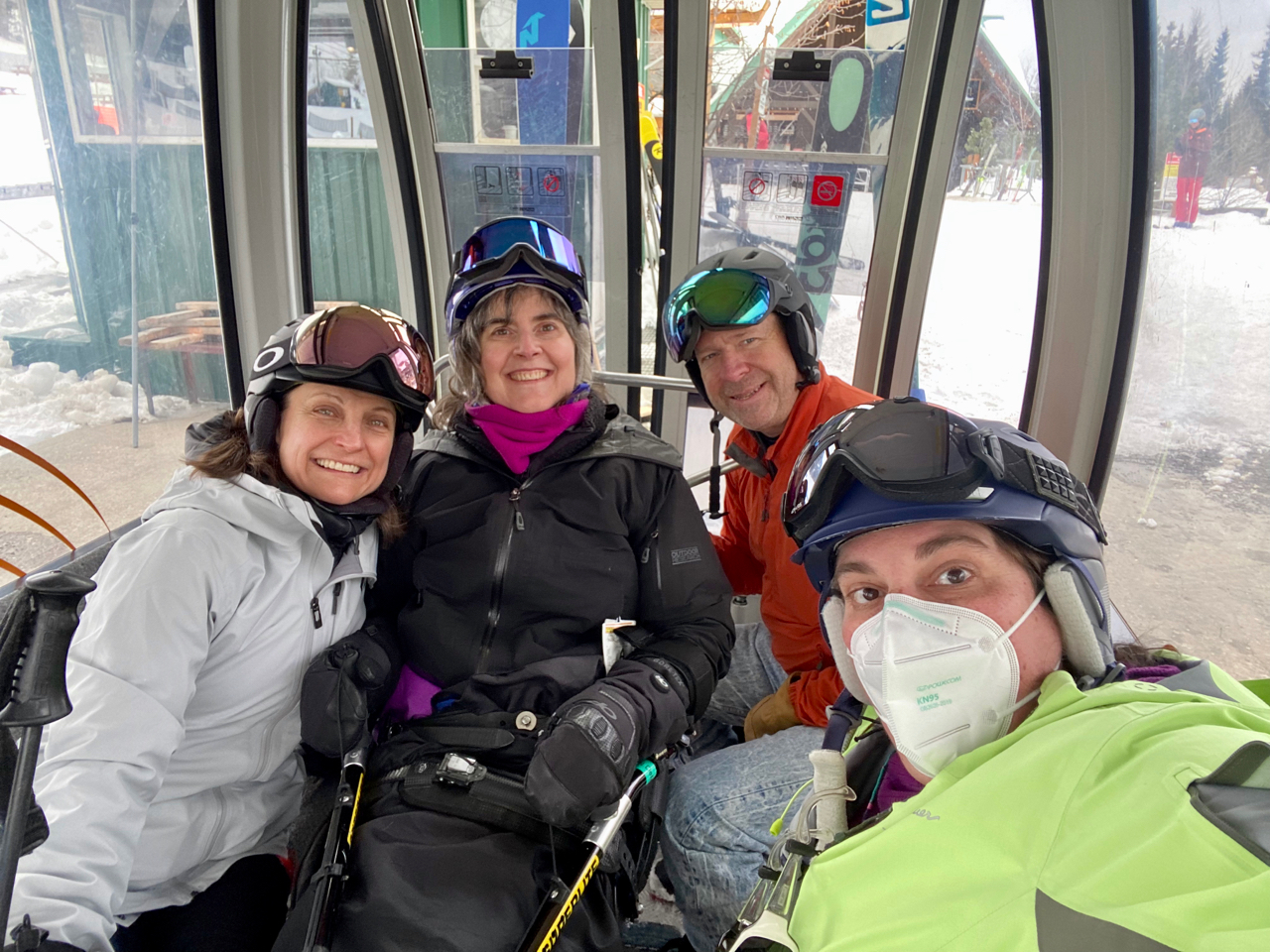
Riding the gondola at Kicking Horse Resort in
Golden, BC (Canada)

Many of my friends love skiing.  Some are so obsessed that they talk of nothing but snow reports as soon as the temperature drops below 50 degrees.  Several of them volunteer with the alpine ski program at Outdoors for All - an organization which offers outdoor adventures to people with disabilities.  It is through my own participation in this ski program that I re-discovered active outdoor life post-wheelchair, leading me to the discovery of other outdoor adaptive adventures and a re-definition of my self-identity.  It is also through this organization that I have met good friends and that I have been able to participate in the ski culture and its discussions prevalent in the Pacific Northwest.


Mountain top wedding at
Kicking Horse Resort

One of these ski-loving friends recently married another ski-loving person, and they aptly exchanged their wedding vows on the top of a 7700 foot mountain at Canada's Kicking Horse Mountain Resort.  


Chalets and lodges at 
Kicking Horse Resort
The mountain-top ceremony was followed by a reception in a chalet at the 3900 foot base.


The way from the gondola
to the wedding terrace

In order to reach the ceremony, guests rode up on the resort's gondola and crossed a swath of snow to reach the restaurant terrace.


In order to reach the reception, the majority of guests donned skis and followed the newly-married couple down the mountain to the reception in the chalet at the base.  About 50 people skied together for nearly 4000 feet down the catwalk and headwalls of the green runs.


I am overwhelmed by the amount of detailed planning that must have gone into this weekend, as well as by the number of people who showed up and and joined the ski procession down the mountain from the ceremony to the reception.  Although the "how" was vague to uncertain until the last minute, with help and creativity, I was able to participate in this amazing weekend.


Waiting for the gondola
on the Dynamique,
on top of the dolly
A major part of my participation was the equipment.  I rented a Dynamique sit ski from Outdoors for All in Seattle, and they included a dolly to transport it.  I transferred from my wheelchair to the sit ski at the lodge's main patio behind the locker room, from where Ted pushed me to the gondola.  At the gondola, the liftees helped me ski onto the dolly.  They then stopped the gondola temporarily, which allowed my friends to push and pull the dolly (with the ski and me on it) into a gondola car. At the top, the gondola was temporarily stopped again, and I was helped out of the gondola to the edge of the concrete (un)loading pad, from which I slid off of the dolly onto the snow.  Ted pushed me across the snowfield to the terrace, while the liftees sent the dolly back down to the base (a procedure they were obviously used to).  


Ted and I skiing down


I watched the ceremony from my ski, and afterward I joined the group for the ski down the mountain to the reception.  I went last, after the skiers and snowboarders, because I ski across the whole face, and because I anticipated falls (I hadn't really skied for years, due to the pandemic).  


Looking over the valley 
from the top
before the ski down

As with many situations, it takes a village.  The bride and groom checked with me about the wheelchair in several situations.  The staff at Kicking Horse -- especially the sales coordinator (Rachel) and the liftees --  were eager to help and to offer suggestions.  The wedding guests --both old friends and new -- held the sit ski, helped slide the ski onto the dolly, helped maneuver the dolly on and off of the gondola, blocked for me while skiing down, and helped to pick me up when I fell over (yes, I did that a few times).  A big thank you to all of them for their help.  


Posing with the bride
after the ceremony

Between the people and the equipment, I was able to participate in an amazing weekend and to feel like a part of the weekend, the festivities, the wedding, and the group.  


Watching the ceremony ...
from outside the terrace!


I can't overstate my gratitude for this feeling of participation and belonging.  It is, I know, not to be assumed or taken for granted, and I was fortunate to experience this confluence of people and opportunity.

I would, however, be remiss, to omit the fact that even in the height of inclusion, I felt like I was on the fringe.  We couldn't stay with the rest of the guests, because the on-mountain lodge was not accessible (no Act for Americans with Disabilities in Canada!), and because stairs prevented me from accessing the food and the restroom at the reception.  This is, in no way, to detract from the kindness and concern of the people involved.  It's just a fact of life for people with disabilities that is probably only noticed/felt by us.

Thursday, December 8, 2022

Redwoods National and State Parks


In my experience, the hardest thing about the Redwoods National Parks was getting there,  I planned to meet my brother and his kids there in Spring 2000 ... but Covid jumped onto the scene, and the parks closed.  After the pandemic closures abated, I hoped to go with my husband, but West Coast wildfires closed that area in in late summer 2000.  Finally, in the summer of 2021 conditions allowed us to meet my brother and family there for several days of tree hugging and neck-crimping gazing.  


and a separate picture
for the tops!
It was a wonderful trip, followed by the second most difficult challenge -- transferring my experience to words online.  Despite a fantastic trip, accompanied by well-documented and accessible trails that were artistically photographed by my teenage nieces, I was stymied by by my own reliance on technology (I usually keep notes on my mobile phone, but there was no electricity to re-charge the battery), as well as the procrastination inherent in a busy life and in human nature.  Of course, the longer I waited, the more difficult it became to reconstruct my travels and travails, based solely on photographs.   Fortunately, others have documented the accessibility of  CA redwood trails in detail, and I can at least provide encouragement to go (GO!) and direction toward some useful information.


Accessible cabin
at Elk Prairie in 
Prairie Creek Redwoods
SP

The northern redwoods region in CA includes Redwoods National Park and 3 state parks.  Redwoods National Park has no developed campground of its own, but it is home to back-country campgrounds, a visitor center, and several redwood groves and trails.  Del Norte Coast Redwoods State Park is the most steep and inaccessible, although Mill Creek Campground and several beach overlooks are wheelchair accessible.  The most accessible hikes are found in Prairie Creek and Jedediah Smith Redwoods State Parks -- each boasting a visitors center, at least one developed campground with a few accessible sites and restrooms, a few accessible cabins, and a network of accessible trails.  


Accesible restroom --
except for the threshold
and the loose gravel!
The great thing about national and state parks is that most of them try to comply with the ADA, whenever possible.  In general, visitor centers, restrooms, vault toilets, picnic grounds are more apt to be accessible than in non-governmental areas.  The problem, of course, is that accessibility -- even ADA compliance -- is not always practical, complete, or even effective.  For example, although there are many "accessible" restrooms in these parks, several of them are built on concrete pads with a 2" threshold (sometimes
adjoining a soft surface).  And the visitor center at Prairie Creek State Park is indeed accessible -- once you get to it, which entails going up a short yet steep bank.


ADA campsite across from
the field of elks
We ended up camping at the aptly named Elk Prairie Campground in Prairie Creek State Park, and our campsite provided front-row observation of the herds of elk grazing in the prairie that draws tree-weary tourists from all over.  Our campsite wasn't very private in front, but it was very accessible -- with a large paved center and a nearby accessible restroom with a separate accessible toilet/shower.  There were also accessible cabins for rent nearby and there were accessible campsites more surrounded by trees behind us (though they seemed more crowded).


The large herds of large mammals were impressive, but the true stars were the redwood trees themselves.  Towering over 200 (and a few even over 300) feet and more than 50 feet around, these giants watched over us mortals as we travelled between groves and craned our heads upward to gaze.  Several of the trails in Prairie Creek Redwoods State Park were wheelchair-accessible (see below). 


Cal-Barrel Road in Prairie 
Creek Redwoods SP


Even those not wishing to hike could take a gentle stroll or roll underneath the trees and feel their majesty. In fact, one could drive on Cal Barrel Road or on the Newton B Drury Parkway and see and feel the giant trees without even exiting the car.


Jedediah Smith Redwoods State Park, at the north end, also offers a multitude of choices for visitors with wheelchairs.  In fact, it was really a coin-toss as to whether we camped there or in Prairie Creek.   This
park also boasts accessible picnic grounds and waysides, redwood groves, campsites, and trails (see below), as well as drives along the big trees. such as the Howland Hill Road. 


The Redwoods parks offer excellent trails for hiking with wheelchairs. Several paved, boardwalk, and dirt trails are firm, wide, and well-maintained, with good thresholds.  Of course, some trails have gentle to serious slope, and there is some cross-slope on hilly areas.  


CA has done an excellent job of documenting slope, cross-slope, and other accessibility features in printed literature and at trailheads.  The non-profit group Save the Redwoods has done an outstanding job of including disabled visitors in its marketing.  In fact, they have actually teamed up with the Disabled Hikers to publish a guide to hiking in the CA redwoods for those with disabilities.  


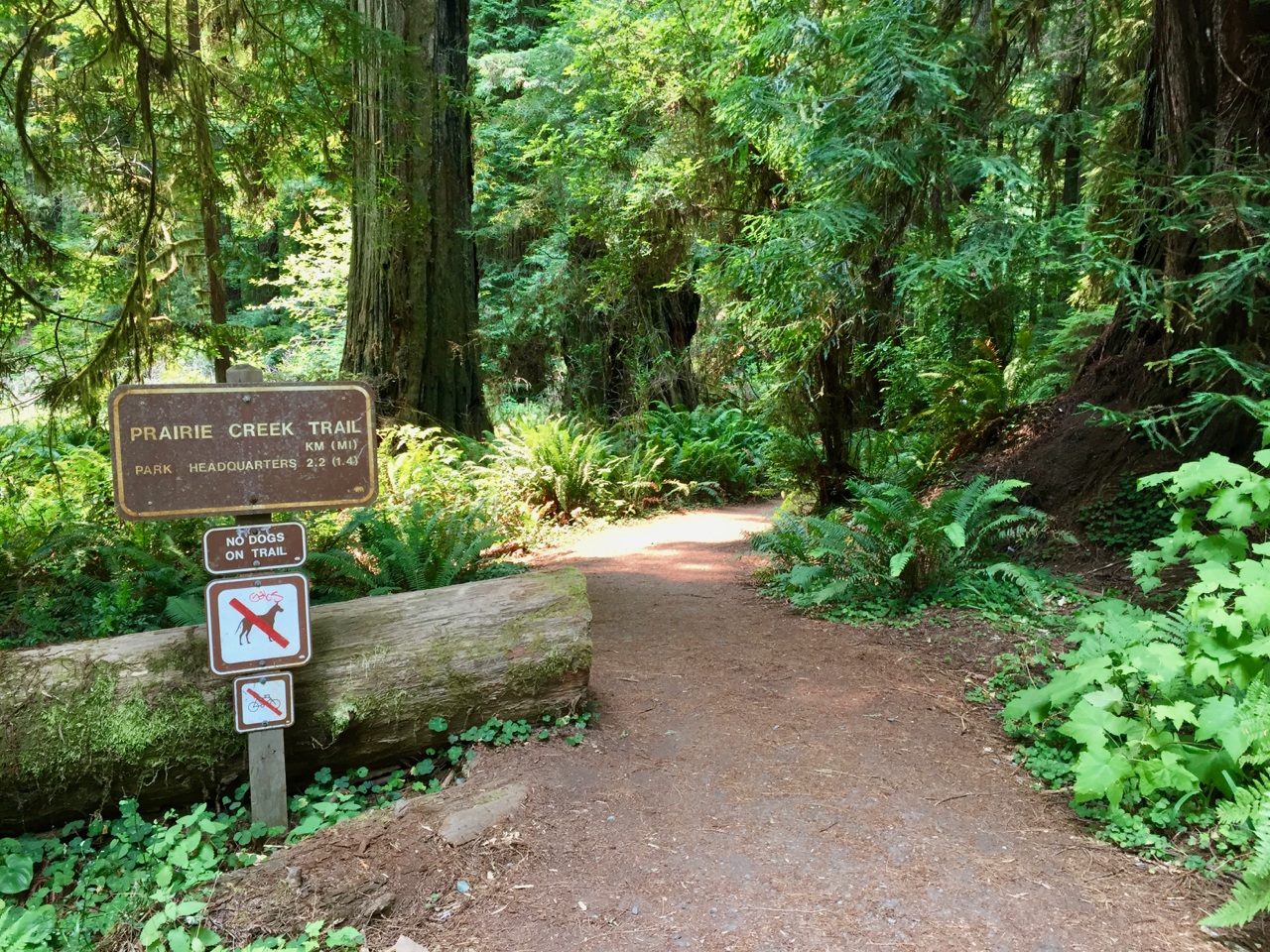
In Prairie Creek Redwoods State Park, Redwood Access Trail (.7 mile ow), Revelation Trail (.3 mile loop), Foothill/Prairie Creek Trail (2.3 mile loop) and the Big Tree Wayside/Circle Trail (.16 mile) are all accessible. 


In Jedediah Smith Redwoods State Park, the Simpson Reed-Petersen Memorial Trails (.93 mile loop) and the Leiffler Trail (.88 mile ow) are accessible.  


Two of the more famous redwood groves are only sort-of accessible but worth it if you can do it.  Stout Grove in Jedediah Smith Redwoods State Park and Lady Bird Johnson Grove in Redwood National Park both are truly magical with their displays of huge trees, surrounded by wood sorrel, ferns, and rhododendrons.  The trails around both groves (. 5 mile for Stout Grove and 1-2 miles for Lady Bird Johnson) are mainly accessible, with wide, moderately firm dirt surfaces that are well-maintained and seem to be kept clear.  (Some areas have slopes steeper than 1:12, so hikers in manual chairs may need assistance in the groves.) 


Entrance to Lady Bird
Johnson Grove
Unfortunately, both groves are reached via a very steep slope.  There are
blog posts from a hiker in a power chair who was able to go down and up, but hikers in manual chairs will definitely need strong assistance. 


I frequently encountered
roots in trails;
almost all could be
circumvented
Keep in mind that this is a land dominated by nature. Even in summer, the air was cool in the woods and even cold and foggy at the coast.  Phone connectivity was spotty to non-existent.  On trails, we frequently encountered tree roots which had broken through above ground or had pushed up the trail in their attempt to do so. Thresholds between trail and bridge or boardwalk were generally well-maintained and low exposure, although I can easily imagine this may change in inclement weather.  There were numerous fallen trees, although in my experience the trails had always been cleared for through-hiking. We had to schedule our travel between parks around major repair work on Highway 101 between the two state parks.


I found the trees and forests magical, the cool temperature lovely, the crowds manageable, and the accessibility surprisingly good.  I have a feeling that recent publications for disabled hikers make accessibility decisions even easier and worth a return trip!


For more info on this area, the following websites may provide helpful information:

https://emerginghorizons.com/californias-accessible-coastal-redwoods/

https://www.savetheredwoods.org/get-involved/visit/disabled-hikers-guide-to-the-redwoods/

http://access.parks.ca.gov/parkinfo.asp?park=12

https://www.visitredwoods.com/listing/disability-accessible-trails/32/

https://www.redwoodskywalk.com/faq/


Many people also visit the redwood trees farther south, where there is a famous drive-through tree, as well as several accessible hikes.  The following websites may provide helpful information:

https://emerginghorizons.com/californias-accessible-coastal-redwoods/

https://www.visitredwoods.com/listing/disability-accessible-trails/32/

http://access.parks.ca.gov/parkinfo.asp?park=22

http://wheelchairtraveling.com/visit-the-california-redwood-trees-with-a-wheelchair-scooter-seniors-accessibility-accessible-hiking-trails/